


Cost Plus vs. Fixed Price in Homebuilding: What's the Difference?
Your guide to understanding homebuilding pricing models
August 6, 2026
8 min
Talking about pricing with a builder can feel uncomfortable, especially if you are rebuilding after a loss or building a custom home for the first time. But the contract type you choose shapes almost everything about your experience, from how confident you feel in your budget to how many surprises land on your desk mid-build.
Two structures dominate homebuilding: cost-plus and fixed price. They handle risk in opposite ways. Understanding the difference now can save you from a painful conversation later, whether you are exploring whether to rebuild your home after a wildfire or planning your first custom home.
What Is a Cost-Plus Contract in Homebuilding
In a cost-plus contract, you pay the builder's actual construction costs, plus a fee on top. The fee usually runs between 10 percent and 25 percent of total costs, and it is meant to cover the builder's overhead and profit.
Your builder invoices you as costs come in for materials, labor, permits, subcontractors, and everything else tied to the project. The fee gets calculated on top of that running total, which means your final number is not locked in until the build is finished.
Here’s a simple example: Say your builder estimates $500,000 in construction costs and charges a 15 percent fee. Your starting estimate would be $575,000. If costs climb to $550,000 due to a material price increase or a scope change, your fee grows as well, to $82,500, and your total becomes $632,500.
Pros of cost-plus contracts
Cost-plus works well when a project's scope is not fully defined at signing. This is common in complex renovations, where hidden conditions behind walls or under foundations only surface once work begins. You also get full visibility into what you are actually paying for, since every invoice is itemized.
Cons of cost-plus contracts
The biggest downside is that you carry the financial risk. If costs run over, whether from material price swings, labor shortages, or scope creep, you absorb the difference. Your builder has less incentive to control spending, since a higher final cost also means a higher fee. Budgets under cost-plus contracts routinely grow well beyond the original estimate.
What Is a Fixed Price Contract in Homebuilding?
A fixed price contract locks in a single total cost before construction begins. You and your builder agree on a number based on your plans, materials, and finishes, and that number holds regardless of what happens with material costs or labor rates during the build.
If costs run higher than expected, the builder absorbs the difference, not you. Your exposure is limited to the change orders you approve yourself, such as upgrading a finish or adding square footage. Using the same $575,000 example from above, if actual costs come in at $550,000 or $600,000, your total stays $575,000 either way, unless you request a change.
Pros of fixed price contracts
You know your number from day one, which makes budgeting and financing far more predictable. It also puts the incentive on the builder to manage costs carefully, since overruns come out of their margin, not yours.
Cons of fixed price contracts
Fixed price bids can look higher upfront than a cost-plus estimate, since builders build in a buffer for the unknowns they are now responsible for. The gap tends to close, and often reverse, by the time a cost-plus project reaches completion. Fixed price also requires your plans and scope to be reasonably settled before signing, since major changes midway through still come with added cost.
Cost-Plus vs. Fixed Price: How the Risk Is Divided
The contract type does not change what a home actually costs to build. It changes who pays when those costs run over.
Three risks show up on almost every build: material price fluctuations, labor overruns, and project delays. Here is how each plays out under the two models.
- Material price fluctuations. Lumber, steel, concrete, and other materials can swing in price over the course of a build, sometimes by a wide margin. Under cost-plus, your invoice reflects whatever the builder pays at the time of purchase, so a mid-project price spike lands directly on your bill. Under fixed price, the builder prices in that risk when they build your estimate, so a later increase comes out of their margin instead of your budget, unless your contract includes a specific material escalation clause.
- Labor overruns. Labor gets priced at signing under both models, but what happens if a project runs longer than planned differs sharply. Under cost-plus, every additional hour of labor, whether due to a scheduling delay or unexpected site conditions, shows up on your invoice along with the builder's fee on top. Under fixed price, that same additional labor is the builder's responsibility to absorb within the agreed price.
- Project delays. This is the risk homeowners tend to misunderstand. Contract type determines who pays for the added construction costs of a delay, such as extra labor or extended equipment rental. It typically does not cover the carrying costs of a delay, like extended construction loan interest, temporary housing, or storage fees. Those costs usually fall on you regardless of contract type, unless you negotiate specific delay damages into your agreement. Worth raising directly with any builder before signing, on either model.
Here’s a side-by-side comparison of how each risk plays out depending on your type of contract:
Here’s a side-by-side comparison of how each risk plays out depending on your type of contract:Cost-plus vs. fixed price: when does each contract type make sense?
Neither model is universally better. The right choice depends on how defined your project is before you break ground.
Cost-plus tends to suit complex renovations, where scope is genuinely uncertain until work begins and flexibility matters more than budget certainty.
Fixed price tends to suit new builds, where plans, materials, and scope can be locked in advance. If you already know what you are building, a fixed price contract gives you a clear number to plan around, with far less exposure to surprises.
The Hidden Costs of Cost-Plus Contracts
Cost-plus projects have a well-earned reputation for exceeding their original estimates, and it usually comes down to a few recurring patterns.
Builders sometimes offer a low initial estimate to win the job, knowing the real number will surface once work is underway. Because the builder's fee is a percentage of total costs, there is little financial incentive to keep spending in check. Every added cost, planned or not, quietly increases what the builder earns.
How allowances and change orders can inflate your budget
Most cost-plus contracts include allowances, which are placeholder budgets for items like flooring, fixtures, or appliances that have not been selected yet. These allowances are frequently set too low, and once you make your actual selections, you cover the gap. Change orders compound the problem, since each one under a cost-plus structure carries the builder's markup on top. This is where most homeowners describe their budget spiraling out of control.
How Homebound's Fixed Pricing Works
We build on a fixed price model. Once you have selected your floor plan, elevation, and finishes, we lock in a price per square foot, and that number does not shift with material market fluctuations. There are no surprise invoices arriving mid-build, and no guessing at what your final cost will be.
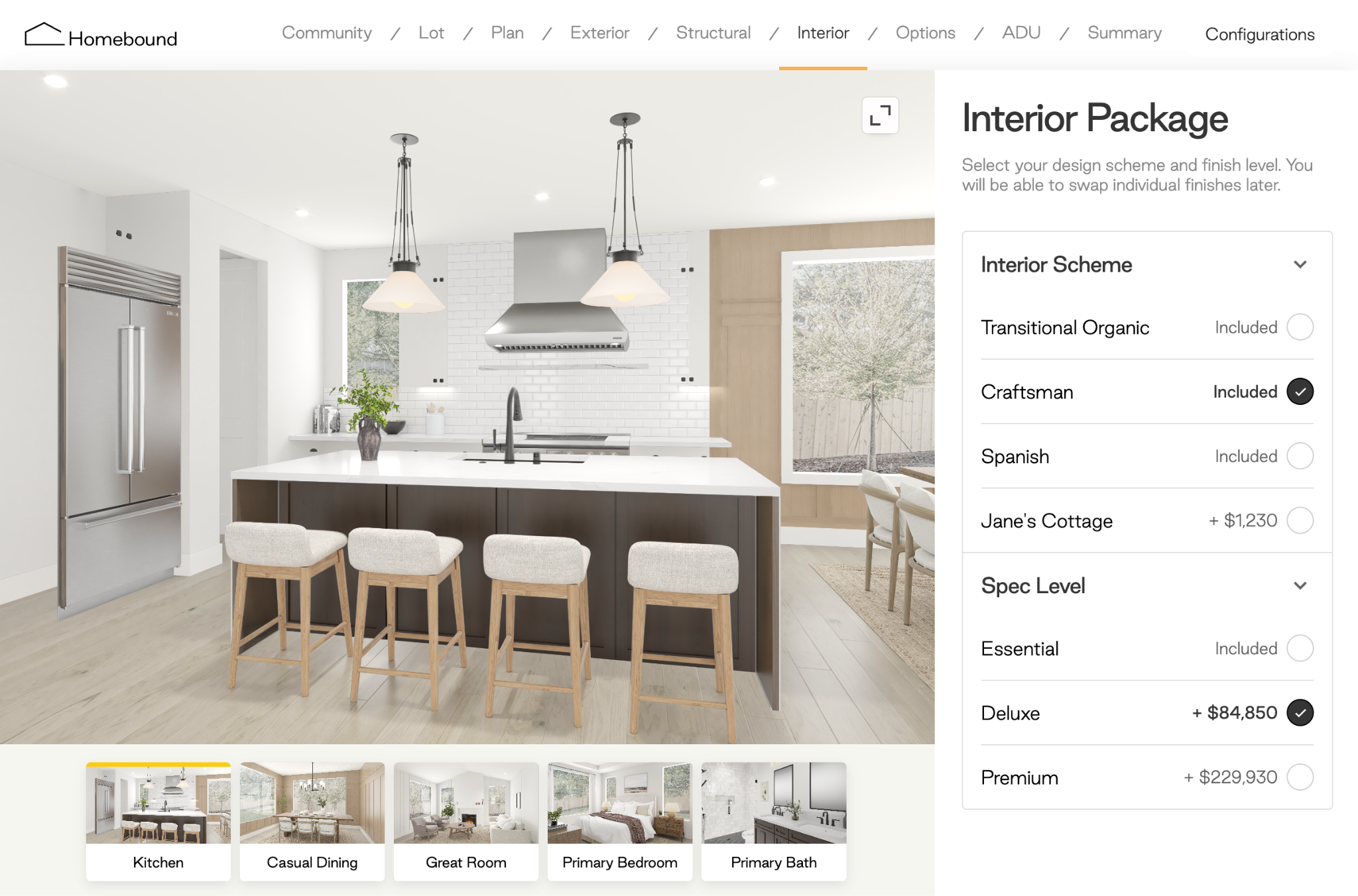
Our Digital Design Studio lets you select floor plans, elevations, and interior finishes and watch your total cost update live as you make each choice. It is a concrete way to see pricing transparency in action, not a marketing claim. As you explore finishes through our home configurator, you always know exactly what your decisions cost.
What to Ask Your Builder Before Signing
Before you sign with any builder, whether they use cost-plus, fixed price, or a hybrid model, ask these questions:
- How are allowances set, and what happens if I exceed one?
- How are change orders priced, and do they carry a markup?
- What happens to my budget if material costs rise during construction?
- Is a Guaranteed Maximum Price (GMP) clause available, and what does it cap?
- How often will I receive updated cost breakdowns during the build?
- What is included in your fee, and what counts as a reimbursable cost?
- If I am building on your lot, does that change how pricing or risk is structured?
Asking these questions upfront does not have to feel adversarial. A builder who welcomes them is showing you they have nothing to hide.
Your contract type decides who absorbs the risk when a home costs more than expected. A fixed price will not always be the lowest number on paper. But it gives you a number you can plan around, from the first day of construction to the last.
Cost-Plus vs. Fixed Price FAQs
What does cost-plus mean in construction?
Cost-plus means you pay your builder's actual construction costs, plus an agreed fee on top, typically 10 percent to 25 percent of total costs. Your final price is not set until the project is complete.
What are the common hidden costs in fixed price construction bids?
Fixed price bids can include a built-in buffer for material and labor uncertainty, which is why they sometimes look higher than an initial cost-plus estimate. The main added cost after signing comes from change orders you approve yourself, such as upgraded finishes or scope additions.
How do change orders work under a fixed price agreement?
Under a fixed price contract, your original price stays locked unless you request a change, such as a new finish or a layout adjustment. Only approved changes get added to your total, so your baseline budget stays protected.
Is fixed price always better than cost-plus?
Not always. Fixed price gives you budget certainty, which suits most new builds. Cost-plus can work well for complex renovations where the scope is not fully known until work begins, since it offers more flexibility as conditions change.
What is a Guaranteed Maximum Price (GMP), and should I ask for one?
A Guaranteed Maximum Price is a cap added to a cost-plus contract, above which the builder absorbs any additional cost. It gives you some of the budget protection of a fixed price contract while keeping the flexibility of cost-plus. It is worth asking for if you are considering a cost-plus arrangement.
Does Homebound use a fixed price or cost-plus contract?
We use a fixed price model. Once you finalize your floor plan and finishes, your price is locked in, so you know your number before construction starts, and it does not shift with material costs.
Building
Home Builders
